New York’s Dirty-Air Corridor

Upper East Side air quality among the worst in the city, mostly because of old boilers. This story was first published Nov. 20, 2013, in Our Town and the West Side Spirit.

In September, Mayor Michael Bloomberg touted the fact that the city’s air quality was the cleanest it’s been in more 50 years, and that air quality improvements have prevented nearly 800 deaths and 2,000 emergency room visits, compared to 2008.

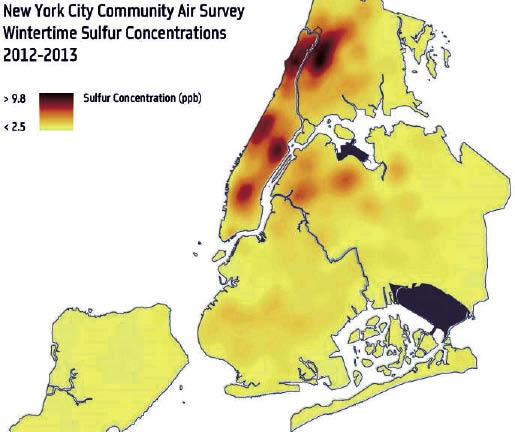
All of which is great – unless you live on the Upper East Side or Upper West Side, which rank among the city’s worst in terms of air quality.

“One of the reasons why pollution levels are high in these areas is due to the high proportion of large buildings burning heavy oil for heat in the neighborhood – typically large co-ops and condos,” said Madeline Kostic of the NYC Clean Heat Initiative.

According to Kostic, a byproduct of burning these heavy oils is that they emit fine particulate matter into the air, which can become embedded in people’s lungs and lead to or exacerbate cardiovascular health problems.

pollution-map_opt

East Side State Assemblyman Dan Quart has made the city’s conversion to cleaner burning fuel alternatives one of his main issues since taking office in 2011. His office estimates that there are more than 3,000 buildings in Manhattan burning the dirtiest type of fuel. The residential nature of the Upper East Side and Upper West Side makes these areas among the worst in the city for particulate matter.

Two years ago, the city’s Department of Environmental Protection issued regulations that requiring buildings to convert to cleaner-burning heating fuel. According to the regulations, all new burner or boiler installations in the city must use one of the cleaner fuels: natural gas, ultra-low sulfur Number 2 oil, biodiesel or steam. All buildings must also convert to cleaner burning fuel when a boiler is retired or by 2030, whichever comes first. Last summer, the city stopped granting new operating certificates for boilers using the dirtiest burning heating fuel.

“The city’s policy has been effective to an extent,” said Quart. “Where it’s been lacking is there hasn’t been the financial resources to incentivize the necessary percentage of conversions that will make a real dent in the air quality.”

Quart said that while the overall air quality has improved in the city, “If you narrow it down to the portion of the Upper East Side that I represent, then the boiler conversions are happening at a slower rate than they are throughout the city of New York.”

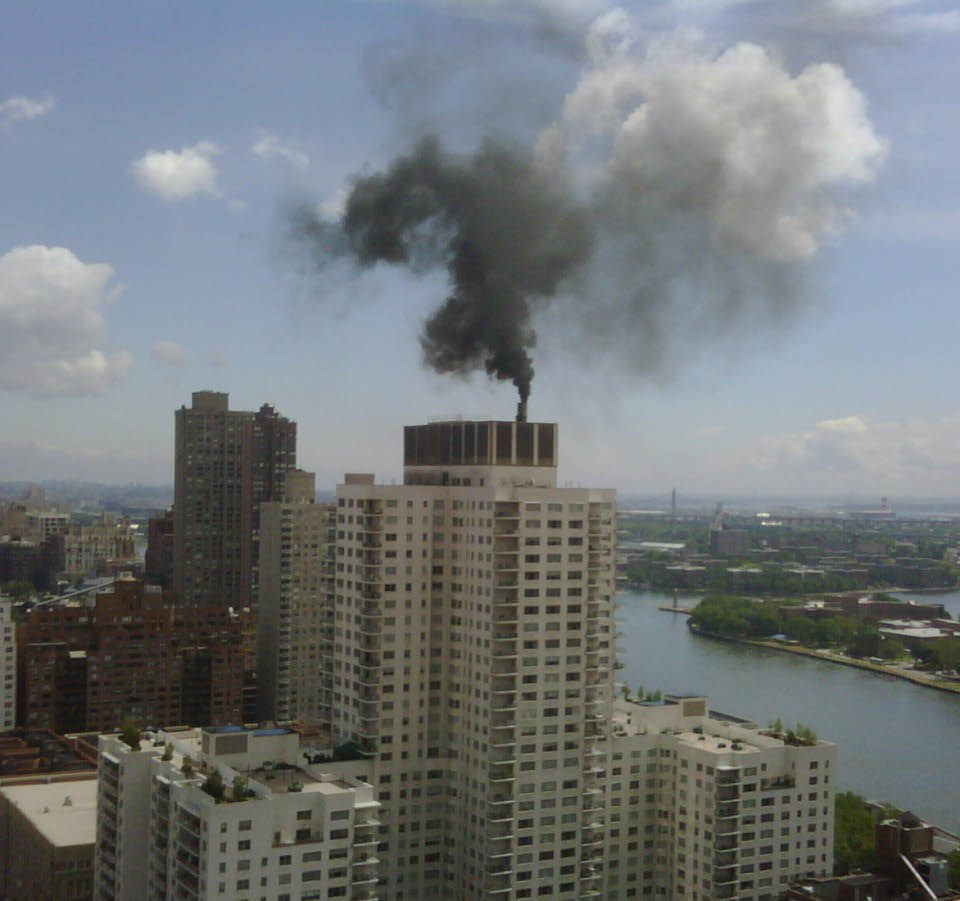
An Upper East Side building burning No. 6 heating oil, courtesy of Isabelle Silverman, Environmental Defense Fund.

An Upper East Side building burning No. 6 heating oil. Courtesy of Isabelle Silverman, Environmental Defense Fund.

Quart has an active bill in the legislature that would provide a tax credit to building owners statewide for the installation of more efficient boilers. He’s also trying to make the essence of his bill a priority in the 2014 budget. His bill also has a sponsor in the State Senate.

Quart said that while Mayor Michael Bloomberg’s environmental initiatives deserve credit for converting 3,000 or so buildings to more efficient boilers, more must be done. The main obstacle is cost. Quart estimated a boiler conversion to the cleaner burning Number 2 fuel costs about $275,000 while a conversion to natural gas costs around $325,000.

“Many buildings…simply can’t afford the major conversions,” said Quart. “If they do anything to move off of Number 6 it’s to the half-measure of [burning] Number 4…the PM 2.5 emissions are still pretty bad with the Number 4 fuel.”

The city’s mandate that buildings convert from burning Number 6 to Number 4 fuel – which will go into full effect in January 2015 – is not enough to reduce particulate emissions, according to Quart. However, he’d like his bill and the necessary funds to be live by then, so that building owners will consider converting to the cleaner burning alternatives when they’re required to convert to Number 4.

Quart hopes his tax credit legislation will provide the push necessary for more buildings to convert to cleaner burning oil. The real conversion that’s needed, said Quart, is for buildings to switch not from Number 6 to Number 4 fuel, but from Number 6 to the cleaner burning alternative Number 2 fuel or natural gas.

“If we have wholesale conversions on that end, I think we’ll a real improvement in air quality on the Upper East Side,” said Quart.

Posted in Misc., News | Leave a comment

A Legacy and a Promise

Upper West Side WWII veteran, civil rights worker, doctor and Jewish scholar Alfred Moldovan passes away at 92. This article was published Nov. 21 in the West Side Spirit

In March 1965, Gay Talese wrote an article in The New York Times about a civil rights march in Selma, Alabama, that focused on a man named Alfred Moldovan, who at the time was the treasurer of the Medical Committee for Human Rights. The committee was formed the year before to lend a medical presence to the civil rights movement and was made up of doctors and nurses from around the country.

The marchers were walking to Montgomery, Alabama – about 50 miles away – to protest discriminatory voting laws. Moldovan traveled from his home on the Upper West Side to be at the march and was driving one of four ambulances next to the column of people as they approached a bridge spanning the Alabama River.

“There was cheering in the church. And there was a feeling of optimism when the marchers lined up,” wrote Talese. “But when the [marchers] began to cross the bridge, the ambulances were not with them.”

The police in Selma prevented the ambulances from staying with the column, which was attacked by troopers in a melee on the other side of the bridge. Talese wrote that Moldovan’s ambulance was eventually given permission to cross the bridge, and that the other three never followed.

“My dad, who had an ambulance with two nurses, said that he was going to cross the bridge, and he approached and was blocked by the police chief,” said Moldovan’s son, Joseph, interviewed last week following the death of his dad earlier this month. “And he said, ‘I’m crossing the bridge.’ The police chief said, ‘If you don’t get out of here I will blow your head off.’ And my father said, ‘You do what you do, but I’m going.’”

Moldovan crossed the bridge and treated scores of injured marchers, including current Georgia Congressman John Lewis.

“He crossed, and his was the only ambulance to make it across that day,” said Joseph Moldovan.

Alfred Moldovan

Alfred Moldovan

Alfred Moldovan stayed in Selma for the next few days, and was an escort as well as a personal physician to Martin Luther King Jr. when King Jr. arrived in Selma soon after the march.

Alfred Moldovan was many things; WWII veteran, doctor of internal medicine, Jewish scholar and collector of Judaica, atheist, father, husband and grandfather. He died Nov. 4 at the age of 92.

Aside from time spent in Italy during WWII, Moldovan lived all his life in New York City. In the late 1960s, when his involvement with civil rights wound down as the movement became more self-determined, Moldovan turned to collecting Judaica and eventually became a well-respected scholar. Joseph Moldovan said that when his father passed away he received hundreds of emails from people around the world who had consulted his father’s expertise in Judaic books, maps and other cultural items.

Around the time that he retired from medicine in 2001 and up until his death, Alfred Moldovan worked to restore and catalogue books that had been donated and acquired by the Jewish Theological Seminary Library. A fire broke out at the library during the 1960s, and many of the books suffered water damage when the fire was put out. Moldovan and a fellow scholar worked two to three days a week restoring the collection.

“My dad could do research in nine languages,” said Joseph. “They would go through the books very methodically telling the library what was worth saving, what was worth conserving.”

His breadth of knowledge was such that Joseph Moldovan’s children, Danny and Jessica, took to calling their grandfather “Zeidipedia,” with “Zeidi” meaning “grandfather” in Yiddish.

“There wasn’t a question you could ask him that he didn’t know the answer to,” Joseph said. “There were five thousand books in my apartment as a kid, and he read them all.”

Alfred Moldovan’s biggest impact was perhaps on his grandchildren, who now both work for progressive, activist organizations. His personal motto was “justify your existence,” and he distilled that creed into his grandchildren, Danny and Jessica, from a young age. Every Friday night they would sleep over at their grandparents’ apartment, giving Joseph and his wife some time off and the kids the best education they could possibly get.

“For both of them, his influence is very self-evident. I think they’re probably his greatest legacy,” said Joseph Moldovan.

In her eulogy to her grandfather, Jessica Moldovan ended with an anecdote about her grandfather.

“On my 21st birthday, surrounded by about twenty of my friends, Zeide got up to make a speech. Wearing beads around his neck and drunk off of sangria, he laid down a challenge to all of us. ‘I spent my life trying to change the world,’ he said, ‘and I failed. You will try to change the world, and you will fail. But you must try.’”

Jessica Moldovan promised they would.

Posted in News | Leave a comment

Remembering the Yippies

Counter-cultural haven on Bleecker Street still alive despite legal struggle. This story was published Dec. 4 in Our Town Downtown

They were there to celebrate the 64th birthday of activist Aron Kay, the Yippie Pieman, so named for his penchant for hurling baked goods at those he’s strongly disagreed with throughout his decades-long activist career, including William F. Buckley Jr. and Phyllis Schlafly.

Yippies – shorthand for members of the Youth International Party – took turns at the mic regaling the crowd with stories of how they met Pieman and the various exploits embarked upon by the organization. Leftist, anti-nuclear, anti-war, pro-marijuana, the Yippies – founded in New York City – have been politically active since the 1960s.

The Yippie Pieman Aron Kay

The Yippie Pieman, Aron Kay

In 1973, Dana Beal, a Yippie pro-marijuana activist, opened the museum at 9 Bleecker Street to preserve all things Yippie and maintained it as a residence. Beal wasn’t at the party because in 2012 he was convicted of transporting 150 pounds of pot in Nebraska and is currently serving a prison sentence. The museum is facing a legal battle with a lender who is attempting to foreclose on the property, and a court date is set for January.

But the legal troubles facing the Yippie Museum seemed miles away at Pieman’s party. Paul DiRienzo, who has long been involved in the Yippie community and met Pieman in the mid-70s, fondly recalled their capers from the 70s and 80s. The Yippie Museum isn’t as involved with social activism as it was back then, but there are still poetry readings and an open mic night every Wednesday. Occupy Wall Street protesters used the museum as a meeting space in 2011.

“Aron Kay, more than anyone I’ve ever met in my life, has taught me how to be an activist,” said DiRienzo, who hosts a progressive talk show called “Let Them Talk” Tuesdays at 8 p.m. on Manhattan Neighborhood Channels. He said there wasn’t a single appearance in New York City by Ronald Reagan that the Yippies didn’t protest.

Pieman himself, who’s confined to a wheel chair, recalled a particularly memorable anti-Reagan demonstration the Yippies held called the “Ballet for Bullets.” They were protesting the Iran-Contra Affair and Reagan was the embodiment of the scandal. The president was attending his son’s ballet performance at Lincoln Center, and the Yippies held a counter-ballet outside in the street.

“Picture myself, a pregnant woman named Ruth, and Dean Tuckerman – who had cerebral palsy – dancing around in tutus, dancing the Ballet for Bullets. We stole the show from them,” said Pieman. “Whenever Ronnie boy would show up, we would have to be the pain in the ass.”

Cake was served and speeches were made. Resistance songs were sung and guitars were strummed. Pieman’s daughter, Rachel Kay, a vegan and animal rights activist, said it was good to see her father, who has health issues, so energetic.

In an interview later, DiRienzo said of the Yippie Museum, “It was like an intellectual salon. That’s what would be the loss if they lost this place, it was a place where people from all over the world came at one time or another. Every amazing type of person, radical activists from any corner of the world you can imagine, passed through the [Yippie Museum] at one time or another.”

From the guerilla-style Rock Against Racism in Central Park to organizing pro-marijuana marches, and of course hounding Reagan whenever he deigned to visit the Big Apple, the Yippies have been a consistent counter-cultural presence in the city.

DiRienzo recalled a device made by the Yippies’ sound guy called the “sound cannon,” which was two giant horns sitting atop a six-foot pole that was connected to an industrial strength cart. The rig could be dismantled into the cart and sealed up, making it impossible for the police – short of using a blow torch – to get into it.

“We could then go and make some hard-core sound,” said DiRienzo. “The city was ours in those days.”

As for the future, DiRienzo isn’t sure what will happen, but he knows that the people who made the Yippie Museum what it is are still around and may have a few tricks up their collective sleeve.

“A lot of people say we should just rent another space,” said DiRienzo. “But there’s an emotional connection to this place that we put our blood, sweat and tears into. It can’t be quantified.”

Posted in News | Leave a comment

Housing Residents Face Forced Moves

Budget shortfall could require Section 8 recipients to downscale. This story was published in Our Town and the West Side Spirit on Aug. 22, 2013. 

Father George Baker had just finished high school when he moved into apartment 9J with his parents at the Knickerbocker Plaza on 91st and 2nd Avenue. This was in 1975, when the Knickerbocker first opened and 86th Street between 2nd and 3rd Avenue was known as Germantown for all its German restaurants. Baker came back to the apartment after seminary in Rome, and was there in 1997 when his father died and when his mother passed two years later. “To this day everyone still knows each other, greets each other,” said Father George, who is 57.

Two years ago, Baker left the apartment he shared with his parents and moved into a smaller one-bedroom in the Knickerbocker. Now, because he receives a Section 8 enhanced housing voucher, he could be forced to downscale again, as the city’s Department of Housing Preservation and Development evaluates his situation under new occupancy guidelines.

Budget cuts in Washington have led to a $35 million shortfall in the Section 8 housing program. To deal with the deficit, the department is moving voucher recipients into smaller units. Under the new occupancy guidelines, a family of two currently living in a two-bedroom unit will have to move to a one-bedroom unit, regardless of the family’s structure. A family of three or four will be downgraded to a two-bedroom unit and a family of five or six to a three-bedroom. A person living alone, like Baker, will be moved from a one-bedroom to a studio apartment.

Enhanced Section 8 tenants will be required to move when a unit in their building or development becomes available. Those who have regular Section 8 vouchers could see their rents increase under new standards that came with the new occupancy guidelines, and will have to choose whether to pay more in rent or request a smaller unit so their share won’t increase.

Residents affected by the changes will be evaluated in October.

Last Tuesday, City Council Member Jessica Lappin and Assembly Member Dan Quart met with about 150 residents of the Knickerbocker, some of whom have lived in the complex since it opened. Quart and Lappin said they would fight to keep people in their homes.

“The HPD didn’t do its job in my view,” said Quart. “There was no public comment, there was no transparency, there was no ability for your legislators or your tenant leaders to comment on the proposed regulations.”

Both elected officials are meeting with the HPD to discuss their objections to the new occupancy guidelines and see what can be done to mitigate its effect.

“This is crazy. I don’t know how else to say it,” said Lappin. “Who’s going to move you? When? Are they going to help the seniors? What if your kids aren’t the same sex? Who’s going to answer these questions for us?”

Those who receive a letter saying they have to move after the October evaluation can appeal the decision to the HPD. Quart said both his and Lappin’s office will be available to connect residents who believe they have grounds to appeal with free legal help.

“We’re going to try and match up as many people who have received a notice with individual attorneys to look at the circumstances and to see if something can be done to at least preclude HPD from downsizing you if you have a legitimate basis,” said Quart.

Rita Popper, president of the tenants association at the Knickerbocker, said she is considering launching a class-action lawsuit against HPD over the changes.

“I think that they counted upon us being old and not doing anything about it and tucking our tail between our legs and wringing our hands,” said Popper. “They didn’t count that we are going to fight this and we are going to win because right is might.”

Of the 577 apartments in the Knickerbocker, 340 tenants receive Section 8 housing vouchers and 220 – or about 38 percent of the building residents – are at risk of having to move after their evaluations in October.

Some residents have already received letters from HPD informing them that they’ll have to move. Robert Hunter, 57, currently lives alone in a two-bedroom unit at the Knickerbocker. He received a letter from HPD in August saying that he’ll have to move to a studio. Hunter, who is an Army veteran and uses a therapy dog to help him cope with schizophrenia, said a studio is too small. He appealed to the HPD with a note from his doctor and is awaiting a decision.

“I couldn’t make it in a studio, I really couldn’t make it,” Hunter said. “It would be too small for me. The disability I have wouldn’t really agree with that.”

An HPD spokesperson said the new occupancy guidelines and subsidy standards are an attempt to keep all Section 8 participants in the program, which has seen massive cuts at the federal level. “The bottom line is that because of sequestration, Section 8 has been greatly underfunded,” said an HPD spokesperson. “We are trying to keep our existing tenants housed, but given the magnitude of cuts to our funding we’ve had to implement measures that require everybody to make some sacrifice so that nobody risks losing their Section 8 benefit.”

HPD administers 37,468 Section 8 housing vouchers in NYC, 11,578 of which are in Manhattan. Of those, 3,700 are enhanced housing vouchers.

Posted in News | Leave a comment

A Woman, Her Disability, and Her Dog

A downtown woman faces challenges navigating the city – and the laws – with her service dog in tow. This article originally appeared in Our Town Downtown on July 17 and another version appeared in Our Town on the same date. 

Wargas rides the L towards 8th Avenue standing up, his tall frame compensating for the sway of the train. Other passengers stare and say to his owner, Cissy Stamm, “that’s a big horse.” Some snap photos with their cellphones while others want to pet him.

Wargas is an enormous Anatolian Shepherd; white, tall and slender with a long tail. He’s a service dog for Stamm, 68, who suffers from Post Traumatic Stress Disorder as a result of sexual abuse she endured as a child. She was diagnosed with PTSD 23 years ago, and Wargas helps her manage her disability.

“Having a disability and having to navigate the world is not easy,” says Stamm. She doesn’t take stairs well and must wait for an elevator at Union Square – the station closest to where she lives – to get on and off the subway.

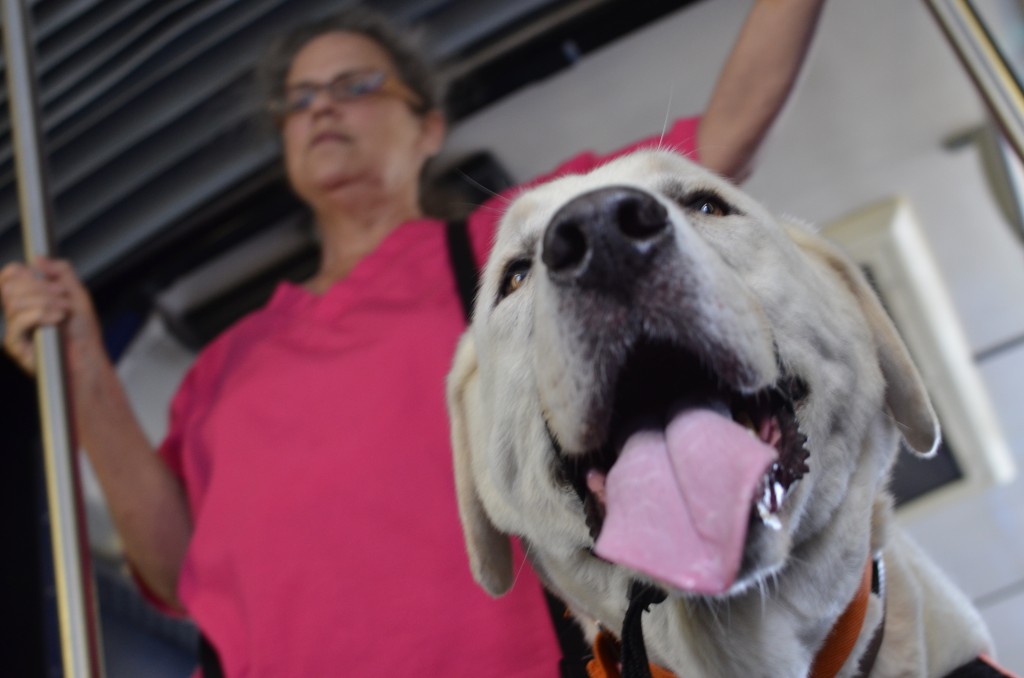
Cissy Stamm with Wargas  on a city bus.

Cissy Stamm with Wargas on a city bus.

Before retiring, Stamm was in advertising where she met her husband, Woody, who takes Wargas for walks where he gets to be a dog like any other, sniffing bushes and greeting other dogs with his great, white muzzle.

Wargas is trained to mitigate disability, says Stamm. Her PTSD manifests itself as hypervigilance, flashbacks and panic attacks and usually surfaces by way of a trigger; tight spaces, crowds, physical contact. The attacks are called “dissociative states,” she says, where she doesn’t know where she is. Wargas acts as a reverse trigger to these states, bringing her back to the here and now with a swipe of the leg or a nuzzle. He also stands in front of her to give her space and serves as a buffer when moving through crowds.

Boarding a train recently, Stamm asks a mother and her son if they’re okay being in proximity to Wargas. The mother says they’re fine.

Exiting the train, Stamm waits for two groups of people to use the elevator before it’s her turn. At the turnstiles exiting the subway she moves through, then turns around and loops the leash around the spindles so it doesn’t get caught, and waits for Wargas to move through (he has to duck).

Stamm said that public access for service animals – subways, buses, restaurants – is getting better but a lot of work still needs to be done. “I rarely have problems,” says Stamm, of using the subway.

 
Restaurants are a different matter. It’s tense in a mostly empty Chinese buffet near 8th Avenue and 14th Street, where the workers are clearly not comfortable with a dog on the premises, let alone one of Wargas’s size. An employee approaches Stamm with uncertainty, and in halting English, says that dogs are not allowed. Stamm informs her that Wargas is a service dog and is allowed, and the employee repeats her earlier claim that dogs are not allowed.

 
Stamm puts food on her plate anyway and moves to the cash register. A different employee tells her that she cannot eat here with a dog, and that she doesn’t want to get in trouble with her boss.

“Some people say even service dogs are allowed now, I don’t know exactly, but usually no,” the cashier tells Stamm and the other employee. “I don’t think you can stay,” she says to Stamm.

Stamm asks for a business card and the cashier says she doesn’t have one and asks her what the law is. Stamm tells her that Wargas is a service dog and under the law, is allowed to be in the restaurant. After some haggling the employees relent. Stamm and Wargas sit down to eat.

“That was relatively normal,” says Stamm, of the experience. “It makes you feel very unwelcome, you’re treated differently than other customers are treated and…you have to argue for your right to be served.”

Stamm navigating a subway turnstile with Wargas.

Stamm navigating a subway turnstile with Wargas.

Situations in which Stamm is denied service exacerbate her potential to suffer flashbacks and panic attacks, a circumstance that many who have service animals for PTSD have to deal with. She says a friend of hers who was suffering a panic attack had to leave a store and lay down on a sidewalk with her dog on top of her to recover. Another friend was denied service at a welfare office and suffered a heart attack, which he survived.

“It’s not just some minor inconvenience,” says Stamm. “It can be life threatening.”

The encounter illustrates a point Stamm made earlier in the day, that those who work in restaurants don’t always receive compliance training for the Americans with Disabilities Act, especially those who don’t speak English well.

Under the ADA, service animals are defined as dogs “that are individually trained to do work or perform tasks for people with disabilities.” This can include guiding people who are blind, alerting people who are deaf, pulling a wheelchair, alerting and protecting a person who is having a seizure, reminding a person with mental illness to take prescribed medications or calming a person with PTSD during an anxiety attack. The guiding benchmark of the law is that a service animal’s work must be directly related to the user’s disability.

The law also says that “state and local governments, businesses, and nonprofit organizations that serve the public generally must allow service animals to accompany people with disabilities in all areas of the facility where the public is normally allowed to go.”

Stamm has fought public access battles – like the relatively mild one at the Chinese buffet – since 1997, when she first began using a service dog. She has successfully sued the transit police and has a lawsuit currently pending against the city and the bus authority, based on 55 access violations she’s dealt with. She believes even though the latest suit hasn’t yet come to a resolution, its existence may have changed the city’s public transit access policies for people with disabilities.

“Public access has a long way to go,” says Stamm, with the biggest areas in need of improvement being restaurants and public transit. She does say that public access has gotten better over the years, and predicts it will improve further with new technologies and the increase in military veterans returning home with disabilities.
She fights back in other ways too, co-founding NY Area Service Dogs, an organization that provides education for people who need service dogs and businesses looking for information on service animal guidelines. The organization also advocates on behalf of people with disabilities or who need emotional support dogs.

Stamm says that when she’s denied service by a business she lodges a complaint with the authority whose jurisdiction the business is in. Action is not usually taken unless the authority levies a fine against that business. When she’s denied service on a bus or subway, she lodges a complaint with the city’s Human Rights Commission.

 
Another obstacle for those who use service dogs are the particulars of the Americans with Disabilities Act itself. For instance, a 2011 update to the ADA clarifies that emotional support dogs are not classified as service animals because they don’t have the same level of specialized training that a service dog must have. This graduated proficiency training acclimates service dogs to crowds and teaches them to abstain from typical dog behaviors; sniffing food, barking, hyperactivity and socialization.

These differences, along with other laws like the Fair Housing Act and the Air Carrier Access Act that can come into play, are cause for confusion for everyone involved in matters of public access. The differing perceptions that business owners, their employees and public transit workers have of these laws all combine to create a public access game of roulette for people with disabilities, especially in urban centers like New York City.

“The public needs to be educated on what an emotional support dog is, what a service dog is, what a therapy dog is, and what the public’s protections are with regards to having an animal that’s out of control or is a nuisance in any way,” says Stamm.

As an example, Stamm says an owner whose service dog is barking or being disruptive or threatening can be asked to leave under the law. Some people assume service dogs must be tolerated no matter what, Stamm says, but that’s not the case.

People with disabilities who use service dogs are “still not in a place where we can expect the same kind of treatment as people who do not have disabilities and are not equipped with service dogs,” says Stamm. “It really is humiliating.”

Later in the day, on a NYC bus, Stamm is holding onto a pole and Wargas is doing his improbable balancing act. People board the bus like they would any other, and then pause when they see the two standing in the aisle. Most are delighted and intrigued to be traveling with a big dog, much like the passengers in the subway before lunch. One passenger offers Stamm some water for Wargas and another strikes up a conversation with her about therapy dogs. It’s an everyday encounter on NYC public transit, where New Yorkers spend so much of their time in close proximity to one another.

However, it only takes one of these encounters to go wrong for Stamm to know that her disability still poses a problem for some, 23 years after the Americans with Disabilities Act became law.

 
“We’re a forgotten minority,” says Stamm. “People with disabilities live invisible lives.”

Posted in News | 1 Comment