
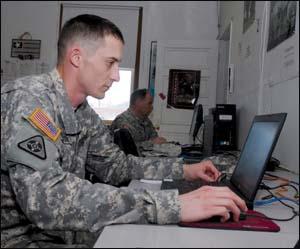
This picture was included in a business teaser that was featured on the NY Times’ website on June 21. Is the man behind the man on the left photoshopped? Is he wearing an out-of-focus turban?

This picture was included in a business teaser that was featured on the NY Times’ website on June 21. Is the man behind the man on the left photoshopped? Is he wearing an out-of-focus turban?
What does the rise in social media mean for a new generation of veterans and the organizations that serve them? This story was published in all nine Straus newspapers on June 16 and 17, 2011.
Jimmy Thonus is home in Pearl River, NY, after serving three seven-month deployments as a Marine in Iraq. He belongs to two veterans’ organizations – the Veterans of Foreign Wars and the Iraq and Afghanistan Veterans of America – but he doesn’t have much to do
with either. Although he hates computers, it’s through Facebook that he keeps in touch with his fellow Marines.
“I guess technically I’m part of a post. I’ve never actually been to it,” said Thonus, 25, whose grandfather signed him up for the VFW. “I’ve stopped into a couple VFWs and had a couple beers with some of the older guys but I really don’t have time to go to the post in between work and all the other stuff.”
The VFW, which peaked in 1992 with 2.2 million members, is down to 1.5 million members, although it remains one of the largest veterans’ organizations in existence. “We know young folks these days have very little discretionary time, especially with both spouses working,” said Joe Davis, a spokesperson for the VFW. “They can become actively involved later in life when they have more discretionary time. Having your name in that membership roll keeps the doors of Congress open.” The American Legion has seen a similar decline in its membership from 3 million in 1990 to 2.4 million today.
Digital warriors
Practically everyone Brandon Friedman met during his two-year deployment in Afghanistan and Iraq was on Facebook or Twitter. Friedman, 33, is now the director of online communications for the Department of Veterans Affairs.
Of the 153 VA medical centers nationwide, 86 now have a Facebook page and 47 have a Twitter feed. These tools are “a great asset to the veterans’ community, but I still maintain that there’s no substitute for face to face interaction among veterans,” Friedman said. “It will be interesting to see if veterans don’t make the effort to reach out to each other and talk to each other and meet each other in person because they have access to social media. That’s something that I watch really closely.”
The Iraq and Afghanistan Veterans of America, which serves 95,000 veterans of those two wars, harnessed social media from the start. “Online was the first place we were,” said Chrissy Stevens, a spokesperson for the IAVA. “It was a big tool in 2004 when we got started to reach people because we were on a limited budget.”
“A lot of people when they’re deployed now, they stay in touch with folks back home through Facebook,” said Stevens. “Troops come back and they continue that same form of communication.”
The IAVA created Community of Veterans, a social media site exclusively for veterans of Iraq and Afghanistan. Last year the site’s membership grew 243 percent to 15,000 users. A big distinction between the IAVA and other veterans’ organizations is that it does not maintain local chapters or posts. This is perhaps the strongest signal that physical communities are being supplanted by digital ones.
John Raughter, a spokesperson for the American Legion, isn’t worried about online interaction replacing the physical variety, even though the majority of his organization’s members are Vietnam-era or older. Raughter pointed to a 1971 Wall Street Journal article that predicted the demise of the American Legion because it alienated Vietnam veterans. “Today, they’re the largest segment of Legion membership,” said Raughter. “Reports of our demise have been greatly exaggerated and premature.”
The need for community
Like Vietnam veterans, soldiers who fought in Iraq and Afghanistan face a unique challenge upon their return home. The current ten-year conflict has two fronts and an entirely volunteer military, which can make it easy to take an attitude of ambivalence towards the wars or ignore them altogether.
“The whole nation has not been involved,” said Dr. Matthew Friedman, director of the National Center for Post Traumatic Stress Disorder (no relation to Brandon Friedman). “In many ways I think the people who have fought in Afghanistan, Iraq, and contiguous areas are not representative of society in general.”
“In rural areas this problem is particularly compounded because there may not be another person within five miles that was deployed or understands these issues,” said Freidman. Social media can help fill that gap by enabling veterans to keep in touch without having to travel, he said.
Raughter of the American Legion wishes more veterans from Iraq and Afghanistan knew about the Legion’s advocacy work in Washington, like the role the organization played in the passage of the new G.I. bill. But while to some degree membership is tied to the amount of clout in Washington, the pedigree of both organizations is well established in Congress. Davis of the VFW said that even though the organization’s membership will decline, the advocacy they do on behalf of veterans and soldiers will go on.
“It doesn’t mean our mission in Washington becomes any less important,” said Davis. “We’re going to keep working no matter what.”
This story was originally published in an alternative story form with supplementary graphics. To download a PDF of this story as it appears in print, click here.

Photo by Daniel Fitzsimmons
A student at House on the Hill Agri-business Child Development Center in Goshen, NY, takes a swing at the pinata during the Cinco de Mayo festivities last week. Cinco de Mayo is a traditional Mexican holiday marking the victory of the Mexican Army over the French Army at the Battle of Puebla in 1862. House on the Hill provides daycare and schooling to 65 children whose parents work in the agricultural sector. House on the Hill is part of a larger network of 13 centers across New York that provide these services. This photo was originally published in the Chronicle.
There was a big hullabaloo when the New York Times activated their pay wall on March 28. Hundreds of comments from disgruntled readers flooded the NYT under the article about the new system when it was activated. If you are Canadian, you had even more of a reason to be outraged.
I read the NYT from two different laptops, at home and at work, so the pay wall isn’t a huge impediment as apparently each IP address gets 20 free articles a month. I didn’t pay too much attention to the issue until I started getting pop-up notices saying that I had “five articles left to read this month” at work, where I suppose I do the majority of my NTY reading. A link on the notice takes you to a letter by NYT publisher Arthur Sulzberger explaining the new system.
“As you may know, on March 17, we introduced digital subscriptions in Canada. The Canadian launching allowed us to test our systems and fine-tune the user interface and customer experience. On March 28, we launched globally,” wrote Sulzberger.
Am I the only one that missed this? Out of all the analysis of what the NYT pay wall means for the future of news I didn’t see one sentence devoted to the fact that the system was perfected on the Canadians. Not that that means anything to the future of news, but there was a lot of coverage on the issue and it is funny that the Canadians were used as lab rats. Maybe I’m just juvenile… Thoughts?
 newshound
HH: I report, you decide
Hendrick Hertzberg addressing a question about race-baiting birthers during a live chat on April 25:
“All Republicans are not racists, but it’s increasingly true that all racists are Republicans. Or at least Republican leaners. However, the G.O.P. has the racist vote locked up, no matter what color the Democratic candidate is. Overt racism, like that of the *Orange County person, is damaging to any sane Republican electoral strategy. The vast majority of Republicans are not, repeat not, racists. A majority of them, however, are xenophobes. There’s a difference. (In the 1850s, the Know Nothings were anti-slavery.)”
Comment from “Mark”
“so now you are attacking republican voters?”
Hendrik’s reply?
“I report, you decide.”
*The “Orange County person” Hendrick refers to was mentioned previously by a commenter and can be found here.