Charlotte Lichtblau, Upper West Side artist, émigré, dies at 88

The German Expressionist remembered by friends and family as ‘Lotte.’ This piece was published Jan. 14 in the West Side Spirit

There’s the framed calendar hanging in the bathroom that she made as a child with her grandmother. The text beneath, written in German, says, “If people knew how much we loved each other they would laugh.”

In the living room is a portrait of her father, Ernst Adelberg, who in addition to getting his Jewish family out of harm’s way in 1938 Vienna, was also instrumental in getting many extended family members to America.

In the dining room is a painting of seemingly disparate objects; a bible and a crucifix, an African mask, a tallow candle and a milkweed pod. “This was her way of seeing the world,” said Claudia Payne, Lichtblau’s daughter.

The bible depicted in the painting – oversized, leather-bound and hundreds of years old – was rescued from a bombed-out monastery in Austria and is still in the family. The African mask sits on a nearby hutch.

Charlotte “Lotte” Lichtblau died on Dec. 18. She was 88.

Lichtblau converted to Catholicism in 1961, a minor scandal among her Jewish-Viennese émigré community at the time. According to those who knew her best, she always considered herself both Jewish and Catholic, and considered the latter a fulfillment of Old Testament orthodoxy.

“She was profoundly convinced that she was both Jewish and Catholic,” said Father Patrick Ryan, a Jesuit priest and lecturer at Fordham University, who delivered her eulogy.

Under the auspices of a family vacation to Zagreb, Yugoslavia, the Lichtblaus made their way to England and finally to St. Louis in 1940. Eventually, the Lichtblaus moved to New York and settled on the Upper West Side. Lichtblau met her husband, Hans, through a local club for Viennese expats.

obit-self-portrait-SP_opt

A self portrait by Lichtblau.

Her friend Bruce Payne, who was married to Claudia and is the caretaker of Lichtblau’s artistic estate, said Lichtblau was something of an outsider in the New York art scene, as it wasn’t exactly in the zeitgeist to earnestly depict religious scenes, let alone take them seriously.

“She was serious about them morally, and she was serious about them in terms of how stories shape our identity,” said Payne. “She was always a bit of an outsider to mainstream New York painting, even though a fair number of New York painters, including Philip Pearlstein, thought highly of her work and always came to see it when it was available to see.”

Despite the emotionally heavy overtones in much of her work, Payne said Lichtblau was a warm person, often hosting lively dinner parties with Hans. “But she was also, you might say, a kind of heavyweight intellectual, and she was unpredictable a little in how she would react.”

Walking around her apartment, at a lifetime of collected work and memory touchstones, it’s apparent that art, and its execution, was inextricably linked to Lichtblau’s experience of life, war, religion and truth.

When asked once by her daughter why she chose to paint a particular biblical scene, Lichtblau replied simply, “I wanted to see it.”
Posted in News | Tagged , | Leave a comment

Fighting for the Soul of Washington Square Park

Some fear the possibility of the famous park becoming privatized. This story was published Jan. 8 in Our Town Downtown.

People who flock to Washington Square Park do so to revel in the pocket of nature in the West Village, for sure, but also to watch unlicensed street performers, take a snooze on a shady bench, engage in people-watching of the most varied order and sometimes sneak sips from brown paper bags or follow plumes of sweet-smelling white smoke. It’s a park for students, drifters, skateboarders, tourists and New Yorkers of all stripes, and many want to keep it that way.

Historically, when conservancies pop up for NYC parks, the results can be beneficial, but also bring some complaints. A 2010 report by Harvard Law School said that private groups participate in the management of half of the city’s 1,700 public parks.

According to the study, “This ‘privatization’ has generated criticism. The manager of Central Park, for example, was severely criticized for refusing to allow a protest during the Republican National Convention, and instead protecting the grass of the Great Lawn. Bryant Park’s management similarly has been criticized for commercializing its park by hosting fashion shows to raise revenue.”

Such conservancies have also been praised as protectors and preservers of public space.

“Historians have hailed the Central Park Conservancy, for example, as the long-awaited ‘protector’ of the park, and the Wall Street Journal has complimented the renovated Bryant Park as the most ‘urbane’ space in the city.”

The study says that critics of public space being privately controlled often say conservancies and the like become unresponsive to community needs as they relate to public space, but the study takes the position that frequently, government agencies, like the parks department, are just as unresponsive to such needs.

WSP-Conservancy_OTDT_opt

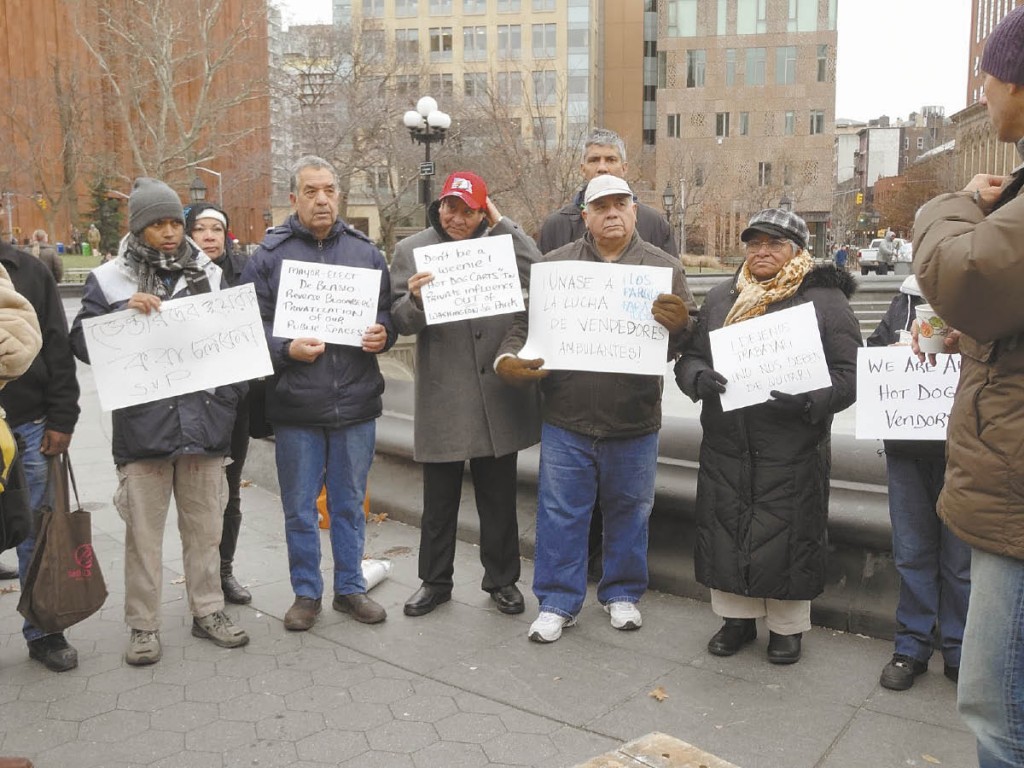
Hot dog vendors stage a rally in Washington Square Park on Dec. 8 protesting the city’s decision to not renew their vending licenses

According to Cathryn Swan, who runs the Washington Square Park Blog, the founding members of this new conservancy presented their plans to the community as a benign organization seeking to simply spruce up the park. The reality, she claims, is something different.

“They basically forced, in my opinion, the same model onto Washington Square Park that occurs at all these other parks but tried to camouflage it as these four nice women who just wanted to form a friends group,” said Swan. “But when you look at the 501c3, they’re not the documents of a little friends group.”

Swan’s referring to the non-profit application the conservancy filed with the IRS, which projects fundraising revenue in the hundreds-of-thousands of dollars in the coming years and includes the ability to award an up to $25,000 bonus for its executive director, who is a parks department employee.

The conservancy’s bylaws, which were made available to The Villager newspaper and posted on their website, calls for a board of anywhere between three and 25 members who will vote on a wide range of initiatives at the park. The conservancy’s executive director is Sarah Neilson, the parks department’s administrator for Washington Square Park.

Swan said the community has resisted pressure to form a conservancy at Washington Square Park for the past 12 years, but that this attempt was successful because of the way it was presented to residents and the community board by the four founding members.

“They may in their minds think they’re insuring the future of Washington Square Park,” said Swan, “but they also have to know what subsequently comes with those conservancies, which is there’s always more commercialization and privatization and private money gets to influence what happens at those parks.”

A major issue for Swan is the relationship between the parks department and the conservancy. In their pitch to Community Board 2 and residents, founding members Betsey Ely, Gwen Evans, Veronica Bulgari and Justine Leguizamo stated they would have no formal agreement with the parks department, including a crucial licensing agreement whereby the parks department could shift operational and maintenance duties over to the conservancy.

However, Swan recently obtained emails through a freedom of information request that showed the conservancy’s Evans, in an email to Neilson, saying, “We look forward to agreeing [to] a license agreement with the City. […] We will make sure that the [conservancy’s] bylaws are changed before the license agreement is executed so that should not be a concern.”

In an interview with the Villager, the conservancy’s Ely said Evans’ email to the parks department was a joke and taken out of context. Neither Ely nor any other conservancy members responded to requests for comment from Our Town Downtown.

Swan points to another sign of what she considers the conservancy changing the nature of the park – the city recently decided not to renew licenses for two hot dog vendors that expired at the end of December. Critics of the decision believe it was really made by the conservancy in an effort to attract more cultured – and pricier – food options to the park.

Geoffrey Croft, President of NYC Park Advocates, said he received calls from angry parks department employees who said Ely made the decision to move the hot dog vendors out of Washington Square Park, contradicting the department’s official stance.

Phil Abramson, a spokesperson for the parks department, denied this and said, “The parks department is definitely retaining all management and control of Washington Square Park.”

Like Swan, Croft believes the conservancy could eventually have real power over Washington Square Park backed by its fundraising efforts.

“I don’t think anyone is against people helping out, as long as that’s what it is,” said Croft. “But generally people don’t get into this without wanting some degree of decision making power.”

Posted in News | Tagged , | Leave a comment

Welcome to the Neighborhood!

Our Town gives the new mayor an East Side primer. This piece was originally published in Our Town on Jan. 2. 

Hello Mr. Mayor, Happy New Year and welcome to the Upper East Side. We’re glad you decided to live in Gracie Mansion, but a bit sad that the city will probably no longer be giving tours through what is now your home (that would be weird; you come downstairs one morning and a couple from Toronto are ogling the grandfather clock).

There’s something you should know right off the bat: nobody on the Upper East Side voted for you, and they’re still pretty upset about the whole marine transfer thing. But it’s your problem now, too, at least for the next four years.

deblasio-Wine-shop-OT_opt

The mayor’s new liquor store?

But really, you’re moving into a nice area. You’ll be doing most of your shopping on York Avenue. Between 86th and 85th Street are two nail salons, three cleaners and a yoga studio, if you have need of such things. There’s a Gristedes on 87th Street but a doorman across from Gracie Mansion said the Fairway at 2nd Avenue and 86th Street is cleaner.

York Avenue between 87th and 86th Street has a Duane Reade and Bagel Bob’s – a good spot for a quick bite. There’s also a liquor and wine store at 87th Street and York Avenue that’ll probably come in handy going forward. York Avenue between 87th and 88th Street has a florist as well as a spa and hair salon for when you need pampering.

The shopping north of 88th Street is pretty sparse, but there’s a shoe repair place at 89th that delivers for free.

Timmy’s Restaurant at 91st and York Avenue is the nearest proper restaurant and you can work off the pounds at Asphalt Green on 91st Street. They’re pretty peeved about the marine transfer station, though, so maybe you should just stick to running along the East River, at least for the first couple years.

The 6 train stops at 86th Street, but you’ll probably take a helicopter to work and land it on your big front lawn – a tale of two yards? On days you decide to schlep it into the office in the back of an SUV try not to snarl traffic too badly.

Most people understand the necessity for these accoutrements; you are a pretty important guy now. And trust us, you’re not regarded as some interloper from Brooklyn who stole the election with an Afro and likes the Red Sox. You won fair and square, and the people on the East Side are a reasonable bunch. Plus, it’ll be good to have the mayor in the manse now. The last guy preferred his lavish townhouse on 79th Street. He’s worth about $31 billion and can do things like run the country’s largest city for $1/year. We assume you’ll opt for the $225,000 pay check – money well-earned we say.

Anyway, we hope you’ll enjoy it up here and we look forward to seeing you at Bagel Bob’s. Enjoy our neighborhood Mr. Mayor and please keep the dog on a leash at Carl Schurz Park.

Posted in Essays | Tagged , , , | 1 Comment

City Hall’s Secrecy Scramble

Community groups complain of lack of disclosure for big development projects. This article was published Nov. 27 in Our Town Downtown.

Two major projects developed in the final months of the Bloomberg administration have prompted residents and neighborhood leaders to complain about a lack of transparency and collaboration as City Hall scrambles to complete its work by the end of the mayor’s term.

The two downtown projects — the development of the South Street Seaport and the relocation of city agencies — have become touchstones in a debate about secrecy and development. “This administration has been the least transparent that I have ever seen,” said John Fratta, chairman of Community Board 1’s Seaport/Civic Center Committee, “especially in these last few months of their administration.”

Most recently, the NYC Economic Development Corp. and the Howard Hughes Corporation were compelled in a letter sent by local elected officials to reveal their development plans for the South Street Seaport. This was after pressure from Community Board 1, community groups and residents failed to yield any information.

The letter to the EDC, signed by five elected officials in Manhattan, including Assembly Speaker Sheldon Silver, said there has been “limited information and lack of meaningful outreach to the community regarding potential development” of the Seaport and urged more transparency and collaboration.

In a different instance where official information has been scarce, details on the city’s Civic Center plan – which proposes to relocate city agencies out of ailing, inefficient buildings into newer and more cost-effective buildings in Lower Manhattan – has been given out piecemeal by city officials and only at the community board’s urging. As previously reported, residents have scrambled to mount opposition efforts to the relocation plans since word of them has spread.

City officials said they informed residents of the moves months ago by way of two public notices in the City Record. CB1 executive committee member Ro Sheffe said the moves were deliberately concealed from residents and two notices “in an obscure government newsletter” is “an outrageous betrayal of civic responsibility.”

Community Board 1 meetings have seen a dramatic increase in attendance since information on both the Seaport development plan and the Civic Center plan has become available. A meeting on Nov. 6 to discuss one of the Civic Center plan moves – which was held in a large NYS Assembly hearing room – was so packed that some attendees were held in the lobby because the room was at capacity.

The majority of those attending the meetings are residents who are opposed to what the city is planning, both with the Seaport development proposal and the Civic Center plan, which is one possible reason why city officials and developers have offered scant details.

In the case of the Seaport, residents and community board members claim that Howard Hughes and the EDC knew what they were planning to build for months but declined to share their plans with residents, despite numerous requests for information. After the letter sent by the elected officials urging transparency, Howard Hughes did release some details – include plans to construct a 50-story residential/hotel tower – to a packed Community Board 1 meeting on Nov. 19.

Robert LaValva, who operates the New Amsterdam Market, an open-air bazaar selling produce and other food-related items in front of the New Market Building, said Howard Hughes was likely being secretive about their plans for the Seaport because they saw what happened with a similar 42-story tower proposal that General Growth Properties made in 2008 when they had a lease on the Seaport. That proposal was met with strong local resistance and was shot down by the city’s landmarks commission. General Growth later filed for bankruptcy.

“I think knowing that that was in the background, that this had been attempted once before and had been met with a lot of opposition, it’s pretty logical to assume that when Howard Hughes got into it for a second go around, they took a much less transparent route,” said LaValva, who for years has championed preservation efforts at the Seaport, rendering him a de facto rallying point and source of information in the community.

“The Howard Hughes Corporation isn’t a small corporation, they didn’t come into this project blind,” Fratta said. “They knew what they were going to do when they purchased the property, they knew there was going to be a tower.”

An EDC spokesperson said the plans presented to Community Board 1 are new and had not been received by the EDC. “It’s clear that [the Howard Hughes Corporation] has now begun to fully engage with the community and will continue to do so as the project evolves,” said the spokesperson.

Before construction on their proposal can begin, Howard Hughes must first get approval from the landmarks commission, then go through a public review process with the city’s planning department, known as the Uniform Land Use Review Process, or ULURP.

Chris Curry, senior executive vice president for the Howard Hughes Corporation, said at the Nov. 19 meeting that the company hopes to clear those hurdles by the spring of 2015. He also said that Howard Hughes would be open to more community collaboration after the new year, and that the final proposal would include a plan to save the financially struggling Seaport Museum.

CB1 will be holding a town hall-style meeting in January with Howard Hughes where residents will have two minutes each to voice their concerns over the proposal.

“The tower is going to stick out like a sore thumb, it’s going to change the whole character of the Seaport, and it’s going to be a major fight between the community and Howard Hughes,” said CB1’s John Fratta.

When asked about the EDC’s role in the Seaport proposal, CB1’s Fratta said he believes the EDC wanted to get the Seaport proposal as far along in the process as possible before the Bloomberg administration leaves office. “The EDC is equally guilty of keeping the community in the dark. They’ve been totally negligent when it comes to really looking at the needs of the community.”

Posted in News | 2 Comments

FiDi Residents Fight On

Opponents of a probation department move plan lawsuit. This piece was originally published Dec. 25, 2013, in Our Town Downtown.

Patrick Kennell, who lives at 80 John Street, has organized a coalition of residents, schools and businesses opposed to the plan, and has hired lawyer Steven Sladkus of Wolf-Haldenstein to represent their interests.

“We are taking steps in that direction,” said Kennell of a possible lawsuit. “We don’t have anything on file yet but that’s where we’re headed.”

The city plans to move the probation department’s Adult Operations Office to 66 John Street, which would include having probationers check in at ATM-like machines at a rate of 200 per week. Financial District residents are fearful that such a move would introduce a criminal element into a highly residential area that’s recently been dubbed “Stroller Ally.”

“This is a criminal justice function that belongs in the Civic Center, it doesn’t belong in any residential neighborhood, let alone the Financial District.” said Kennell, a lawyer with two sons, aged 3 and 6.

By way of precedent, residents of Tribeca were successful in their recent bid to halt the city’s plan to move a criminal summons court to 71 Thomas Street. In that case, restaurateur Lynn Wagenknecht and others launched a suit against the city claiming it had not completed a sufficient environmental review before it approved the move. The city abandoned its plan in return for Wagenknecht dropping the suit.

Kennell said he and others hope to emulate the Tribeca residents’ success. “We think our neighbors in Tribeca did a fantastic job and we’re hopeful we can get the same result,” said Kennell. “I think we have some similar arguments.”

Both moves are part of the city’s 21st Century Civic Center Plan, which seeks to move city agencies out of aging and inefficient buildings into more modern digs throughout Lower Manhattan. The Civic Center encompasses the area around City Hall and includes buildings that are home to the city’s various criminal justice courts and other law enforcement entities.

The city has drawn heated criticism from Community Board 1 and residents over the lack of details it’s offered on the moves. Residents only learned of the probation department plan after a city official let it slip at an unrelated CB1 meeting in October. Later, the city claimed it informed residents by way of the City Record, a public notice bulletin published by the Dept. of Citywide Administrative Services. At an over-capacity November meeting called to address the probation department move, nobody raised their hand when asked if they had heard of the City Record.

Kennell’s lawyer, Steven Sladkus, said the suit could be filed before year’s end.

“The lawsuit, generally speaking, is challenging the city’s decision to move the probation office to [John Street],” said Sladkus. “It’s also raising issues that the city did not follow all required procedures in assessing the issue before making that decision.”

Two other moves are scheduled around city agencies at 1 Centre Street and 100 Gold Street. City officials have not responded to repeated requests from Our Town Downtown for details on those plans.

As for the coalition suing the city to stop the probation department move, Kennell said it’s made up of many interested parties in the Financial District, but that only a few will be named in the lawsuit itself. Kennell said he started an online petition opposing the move soon after it was discovered that has since garnered 1,260 signatures.

When asked about the possibility of facing a lawsuit to stop the move, which is planned for early 2014, a spokesperson for the probation department said, “We remain committed to ensuring that the move does not cause any disruption in our new neighborhood.”

Other city officials did not respond to requests for comment.

“People are rip-roaring mad about this and the city has been so cavalier about this issue it’s mind-boggling,” said Sladkus. “That’s going to be demonstrated in our papers.”

Posted in News | Tagged , , , , , , | Leave a comment